
প্রিন্ট এর তারিখঃ ডিসেম্বর ৩০, ২০২৫, ১০:৫২ পি.এম || প্রকাশের তারিখঃ ডিসেম্বর ৩০, ২০২৫, ৬:০৭ অপরাহ্ণ
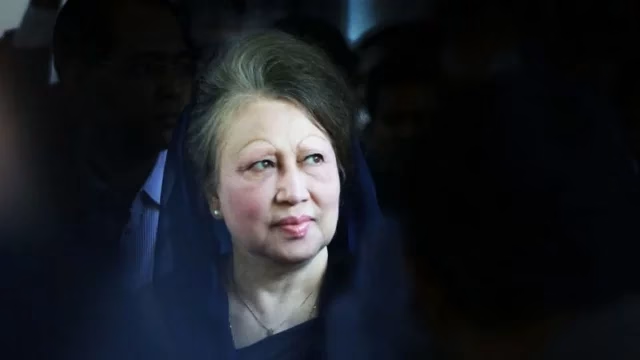
Khaleda Zia, BNP Chairperson and Former Prime Minister, Passes Away
Swapan Kumar Singh :
Published: Tuesday, December 30, 2025
Former Prime Minister and Bangladesh Nationalist Party (BNP) Chairperson Khaleda Zia has passed away. She breathed her last at around 6:00am on Tuesday while undergoing treatment at Evercare Hospital in the capital. She was 80.
The BNP chairperson’s press wing official, Shamsuddin Didar, confirmed the matter. BNP Secretary General Mirza Fakhrul Islam Alamgir later also confirmed her death to the media.
Khaleda Zia was surrounded by her family members during her final moments. Her elder son and BNP Acting Chairperson Tarique Rahman was by her side. Also present at the hospital were Tarique Rahman’s wife Dr Zubaida Rahman, their daughter Zaima Rahman, and Shamila Rahman Sithi, wife of the late Arafat Rahman Koko.
Among other family members, Khaleda Zia’s younger brother Shamim Eskander, elder sister Selina Islam and close relatives were present. BNP Secretary General Mirza Fakhrul Islam Alamgir and members of the medical board overseeing her treatment were also at the hospital.
According to BNP sources, details regarding her janaza and burial will be announced later.
Prolonged illness
Khaleda Zia had been suffering from multiple health complications for a long time, including liver cirrhosis, arthritis and diabetes. She also had chronic conditions affecting her kidneys, lungs, heart and eyesight.
She was admitted to Evercare Hospital on November 23 after infections were detected in her heart and lungs.
A medical board led by cardiologist Dr Shahabuddin, comprising specialists from Bangladesh, the United Kingdom, the United States, China and Australia, was overseeing her treatment. Although there were plans earlier this month to take her abroad for advanced treatment, her deteriorating physical condition made it impossible.
Political journey
Khaleda Zia was the first woman to serve as Prime Minister of Bangladesh. She assumed office in 1991, playing a pivotal role in restoring parliamentary democracy in the country. Under her leadership, the parliamentary system was reinstated and the caretaker government system was introduced to ensure free and fair elections.
She served as prime minister in three terms—in 1991, 1996 and 2001. Khaleda Zia earned the reputation of an “uncompromising leader” for her role in leading movements against the military rule of Hussain Muhammad Ershad.
Personal life
Born in 1945 in Jalpaiguri, India, Khaleda Zia completed her education in Dinajpur. In 1960, she married Ziaur Rahman, then an officer in the Pakistan Army.
During the 1971 Liberation War, she was detained by the Pakistani forces and was released after Bangladesh achieved independence.
Following the assassination of Ziaur Rahman in 1981, Khaleda Zia entered active politics. She became the chairperson of the BNP in 1984 and remained in the position until her death.
Final years
Khaleda Zia was sent to jail in 2018 after being convicted in corruption cases. Her later years were marked by prolonged legal battles and deteriorating health.
She was released temporarily through an executive order during the Covid-19 pandemic. In August this year, she was granted full remission by presidential order.
With her passing, Bangladesh’s politics has witnessed the end of a long and significant chapter.
RED TIMES LIMITED
116-117, Concord Emporium, Kataban, Dhaka-1205.
Mobile: 017111-66826
Email: redtimesnews@gmail.com
Copyright © 2025 RED TIMES. All rights reserved. প্রিন্ট করুন
 সেভ করুন