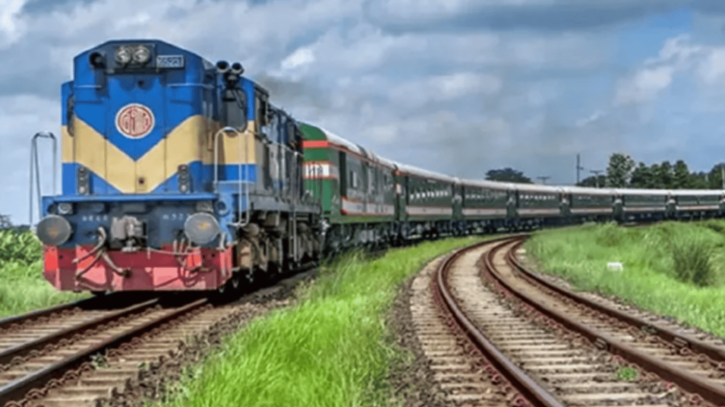
Bangladesh’s railway sector has witnessed unprecedented infrastructure development over the past decade, with more than Tk 1.22 lakh crore invested in new rail corridors, bridges, stations, and network modernisation projects. Yet a significant portion of the country’s rail infrastructure remains underutilised, exposing a widening gap between physical expansion and operational capacity.
According to railway data, train services are currently absent on approximately 316 kilometres of rail tracks across the country. Of these, 180 kilometres are located in the eastern zone, while 136 kilometres fall under the western zone.
The situation has raised concerns among transport experts, who argue that infrastructure development alone cannot deliver the expected economic and social benefits without adequate rolling stock, manpower, and operational planning.
One of the most prominent examples is the Dhaka-Cox’s Bazar rail connectivity initiative through the Dohazari-Cox’s Bazar line. Constructed at a cost of Tk 11,335 crore and inaugurated amid much public enthusiasm, the 101-kilometre route was originally projected to accommodate 23 pairs of train services. However, only a handful of intercity and local trains currently operate on the line.
A similar scenario is unfolding on the Padma Bridge Rail Link. Despite being one of the country’s flagship transport projects with substantial operational potential, train services remain well below projected levels due to shortages of locomotives and passenger coaches.
Meanwhile, the Ishwardi-Rooppur rail line, developed primarily to support the Rooppur Nuclear Power Plant project, has yet to witness regular train operations despite the completion of infrastructure works.
Railway officials acknowledge that the primary challenge is no longer track construction but the lack of supporting resources required to run services efficiently.
Bangladesh Railway currently operates with a limited fleet of locomotives and passenger coaches, a considerable portion of which have already exceeded their economic lifespan. The manpower situation is equally challenging. Against an approved workforce of nearly 48,000 positions, fewer than half are currently filled, forcing authorities to keep around 130 railway stations closed.
Industry observers point to a longstanding planning mismatch, where infrastructure projects are implemented without parallel investments in rolling stock procurement and human resource development. As a result, several newly completed rail corridors have struggled to achieve their intended operational capacity.
Transport analysts argue that the country’s growing demand for rail travel presents a significant opportunity. Passenger demand continues to outpace available services, particularly on major routes. However, without expanding locomotive fleets, coach inventories, and operational staffing, the benefits of large-scale investments may remain largely unrealised.
Railway authorities say efforts are underway to procure new locomotives, coaches, and wagons, while plans are also being formulated to activate underutilised routes and maximise network efficiency.
Despite impressive gains in railway infrastructure over the last decade, the sector now faces a critical challenge: transforming newly built assets into fully functional transport services. For many observers, the next phase of railway development will be judged not by the kilometres of track laid, but by the number of trains that actually run on them.